
Publications and Scientific Rigor
SCIENTIFIC FOUNDATION
Foundation for Creating a Trustworthy Repository
The creation of a trustworthy CESAR repository requires a rigorous curation process in the XAIBIM Studio. The methodology is founded on the ability to process unstructured information assets through deep learning [47] and organize them within an integrated semantic framework to ensure their logical consistency [48].
[47]: X. D. Wang, T. J. Li, et al., 'Reconstructing as-built beam bridge geometry from construction drawings using deep learning-based symbol pose estimation,' Adv. Eng. Inform., (2024). DOI: 10.1016/j.aei.2024.102808[48]: Y. C. Li, P. A. Zhao, et al., 'BIM-integrated semantic framework for construction waste quantification and optimisation,' Automat. Constr., (2024). DOI: 10.1016/j.autcon.2024.105842METHODOLOGICAL FRAMEWORK
Dual Methodology: Curation and Reasoning
The XAIBIM methodology is based on a strict separation of functions: the XAIBIM Studio handles knowledge curation and management throughout the asset's lifecycle [49], while the XAIBIM Nexus focuses exclusively on neuro-symbolic reasoning from this validated knowledge [50].
[49]: Q. M. Lu, J. L. Chen, et al., 'From design to operation: Multi-agent AI for virtual in-situ modeling of digital twins in BIM,' Automat. Constr., (2025). DOI: 10.1016/j.autcon.2025.106477[50]: A. B. Zhang, W. H. Li, et al., 'Automating the retrospective generation of As-is BIM models using machine learning,' Automat. Constr., (2023). DOI: 10.1016/j.autcon.2023.104937TECHNICAL ARCHITECTURE
The Neuro-Symbolic Hybrid Architecture of XAIBIM Nexus
The technical architecture of the XAIBIM Nexus validates the neuro-symbolic hybrid paradigm. A connectionist layer with Graph Neural Networks (GNNs) for topological analysis [51] is integrated with a symbolic layer using ontologies and logical rules (SWRL) for formal verification [52].
[51]: J. M. Chen, Q. B. Wang, et al., 'Graph Neural Networks for building and civil infrastructure operation and maintenance enhancement,' Adv. Eng. Inform., (2024). DOI: 10.1016/j.aei.2024.102868[52]: L. N. Li, K. M. Yu, et al., 'Artificial intelligence to enhance BIM-BEPS integration via IFC: Challenges, solutions, and future directions,' Adv. Eng. Inform., (2025). DOI: 10.1016/j.aei.2025.103824SCIENTIFIC CONTRIBUTIONS
Contribution to Explainable AI in Construction
Our scientific contribution establishes CESAR as the essential knowledge base (grounding) for reliable generative AI in construction [53]. This positions XAIBIM Nexus as an Explainable AI (XAI) tool designed for uncertainty management and robust optimization in civil engineering projects [54].
[53]: Y. Gao, G. Xiong, et al., 'Exploring bridge maintenance knowledge graph by leveraging GrapshSAGE and text encoding,' Automation in Construction, (2024). DOI: 10.1016/j.autcon.2024.105634[54]: L. M. Torres, G. R. Santos, et al., 'Multi-objective robust optimization for enhanced safety in large-diameter tunnel construction with interactive and explainable AI,' Reliab. Eng. Syst. Saf., (2023). DOI: 10.1016/j.ress.2023.109172OPEN SCIENCE
Repositories and Reproducibility
We guarantee reproducibility through open source. Using semantic rules (SPARQL) for logical verification in the Nexus [55] and developing open-source pipelines for data processing in the Studio [56] are examples of our commitment to open science.
[55]: H. P. Chen, S. L. Wu, et al., 'A Semantic Approach for Automated Rule Compliance Checking in Construction Industry,' IEEE Access, (2021). DOI: 10.1109/ACCESS.2021.3108226[56]: R. S. Jones, M. E. Davis, et al., 'Open-source automatic pipeline for efficient conversion of large-scale point clouds to IFC format,' Automat. Constr., (2025). DOI: 10.1016/j.autcon.2025.106303
Doctoral Forum: Debates and Frontiers of Trustworthy AI
XAIBIM proposes the transmutation of passive information assets into a computable and multidimensional knowledge ecosystem (from 2D to 10D). This project is articulated through three fundamental axes to address knowledge fragmentation in the AECO sector: Curator, Engine and Experience.

XAIBIM Studio Reliability: LLMs, Multimodal Extraction and Bias Risk
The XAIBIM Studio uses LLMs for knowledge extraction. The debate focuses on the fragility and bias of these models in the face of engineering jargon [57] and how Human-in-the-Loop control can, paradoxically, amplify bias if not quantified with consistency metrics like Fleiss' Kappa [58].
[58] '"Estimating demolition waste from residential interior photos: A Large Language Model solution,"' Automat. Constr., 2025. DOI: 10.1016/j.autcon.2025.106478.

XAIBIM Nexus Limits: Scalability of Neuro-Symbolic Reasoning
The hybrid paradigm (GNN/SWRL) of XAIBIM Nexus is the core of inference. The debate questions whether this synergy can scale to multidimensional analysis (4D/5D) [59] without introducing algorithmic fragility that compromises the reliability required of Trustworthy AI in construction [60].
[60] '"Trustworthy AI and robotics: Implications for the AEC industry,"' Automat. Constr., 2022. DOI: 10.1016/j.autcon.2022.104298.
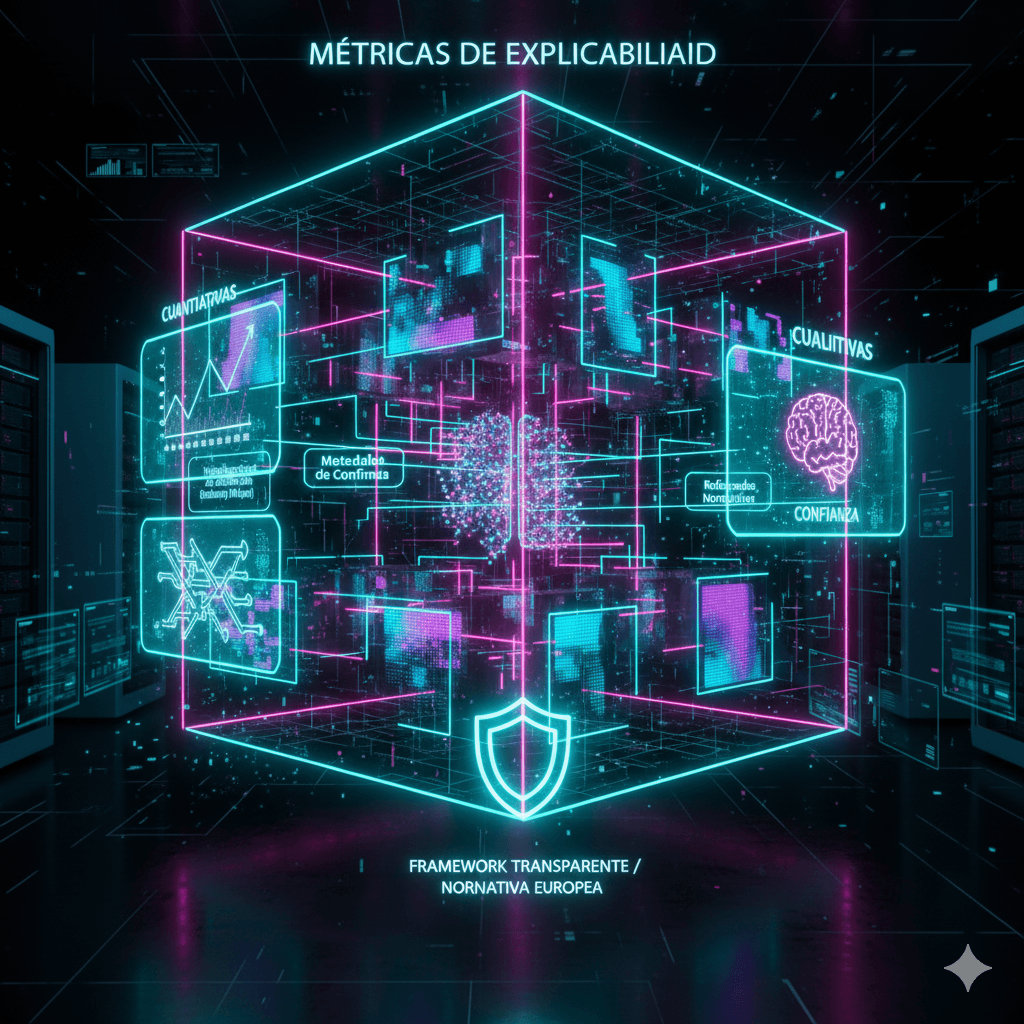
XAI and Open Knowledge Responsibility
The transparency of XAIBIM Nexus is validated through explainability metrics (XAI) [61]. The ethical and professional debate focuses on the attribution of responsibility when the engine's logic is transparent and how access to the open knowledge of CESAR [62] impacts the validation of the engineer's judgment.
[62] '"Graph-based method for extracting spatial information from semi-formal text...,"' Automat. Constr., 2025. DOI: 10.1016/j.autcon.2025.106418.
Strategic Agenda and Vision
XAIBIM and European Obligatory Routes
The XAIBIM agenda is structured into a phased Digital Twin (DT) lifecycle [63], transitioning from data governance to professional Cognitive Augmentation. Development is rigorously iterative and structured [64], anchored in three fundamental axes: Curator (Phase I), Engine (Phase II), and Experience (Phase III).
[64]: M. A. Abuhussain, et al., 'Integrating Building Information Modeling (BIM) for optimal lifecycle management of complex structures,' Structures, (2024). DOI: 10.1016/j.istruc.2023.105831
ISO 19650
MANDATORY BIM IMPLEMENTATION (Critical Path)
REGULATED AI
EU AI Act and Data Governance
AGENDA 2030
SDGs and Infrastructure Resilience
AGENDA 2050
Multidimensional Inference and Climate Neutrality
FUTURE
Digital Twin and Cognitive Augmentation

MANDATORY BIM IMPLEMENTATION (Critical Path)
The XAIBIM project is a response to the BIM mandate in Europe. ISO 19650 requires information traceability and consistency, making the use of the Curator (Phase I) indispensable for structuring data (e.g., for BIM dimensions like 8D) [65]. The Engine, by formalizing logic, is the mandatory technical route for Automated Compliance Checking (ACC) of digital regulations, integrating semantic validation with engineering technical analysis [66].
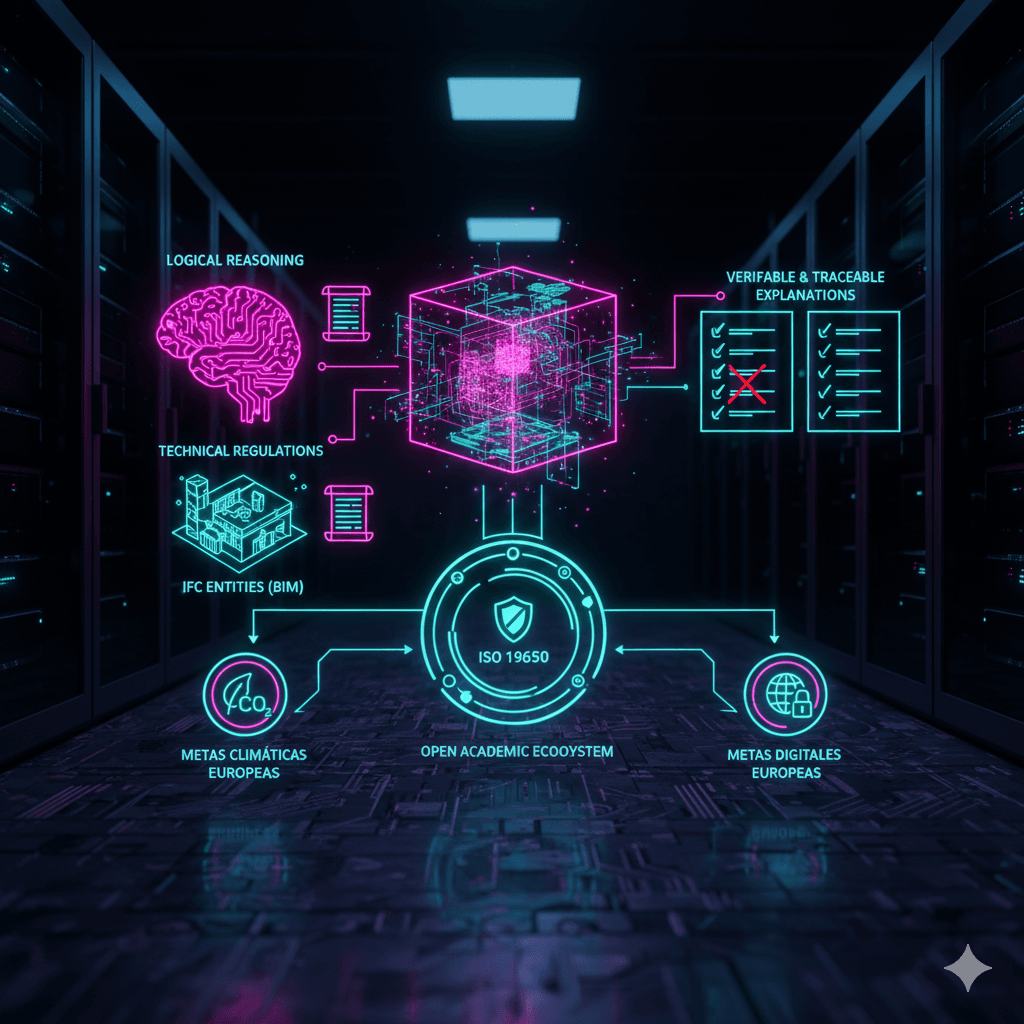
EU AI Act and Data Governance
XAIBIM's design addresses data governance under the EU AI Act. By focusing on multimodal extraction [67], our system generates a training corpus that guarantees information reliability and traceability, mitigating algorithmic risks by employing ontology-based frameworks for formal regulatory verification [68].

SDGs and Infrastructure Resilience
XAIBIM contributes to SDGs 9 and 11 by providing the auditable data corpus (CESA) that is fundamental for reliable risk and resilience modeling [69]. The Engine implements risk modeling [70], demonstrating that sustainable infrastructure innovation is based on verifiable and dynamic Digital Twin information.
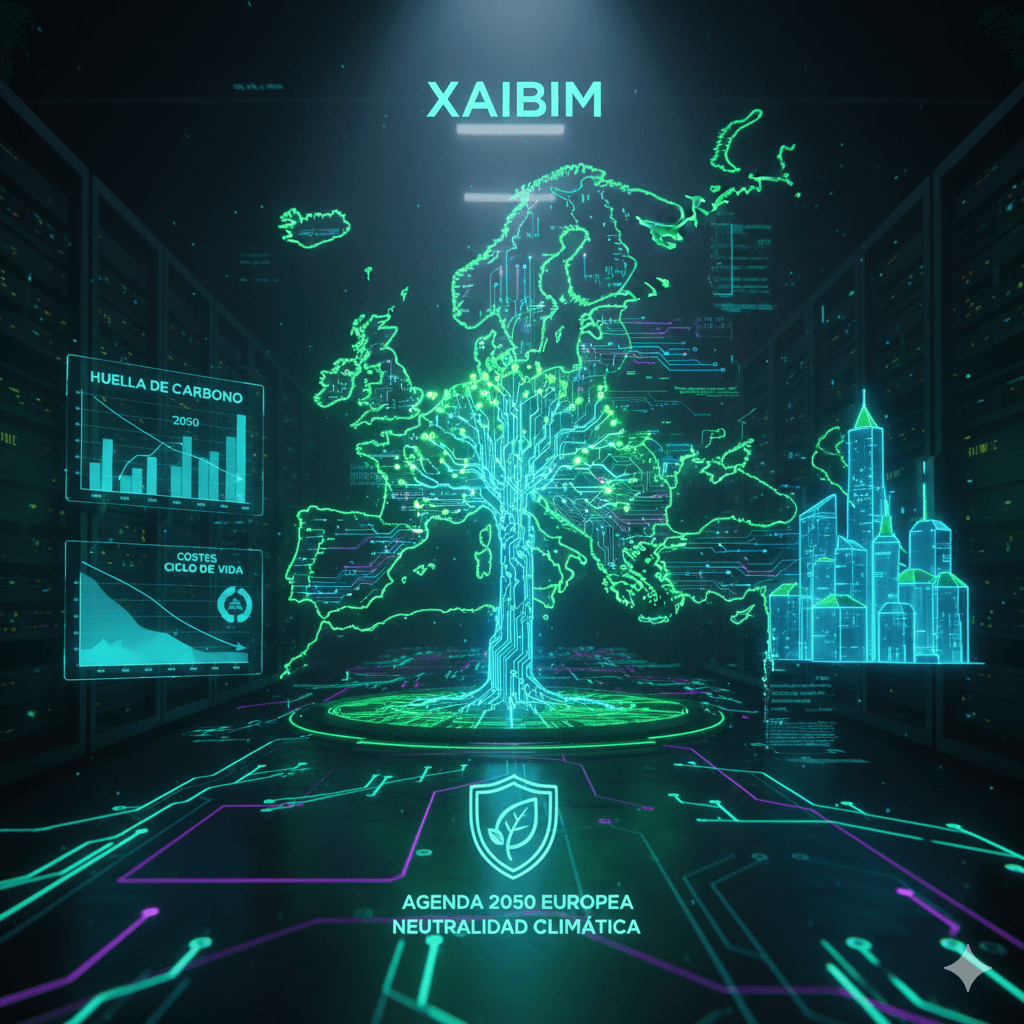
Multidimensional Inference and Climate Neutrality
Through its neuro-symbolic pipeline (Engine Axis), XAIBIM provides tools for accurate Life Cycle Assessment (LCA/LCC) of assets [71]. This is fundamental to meeting European Green Deal objectives, quantifying carbon footprint (6D) and optimizing design for climate neutrality through dynamic Digital Twins [72].
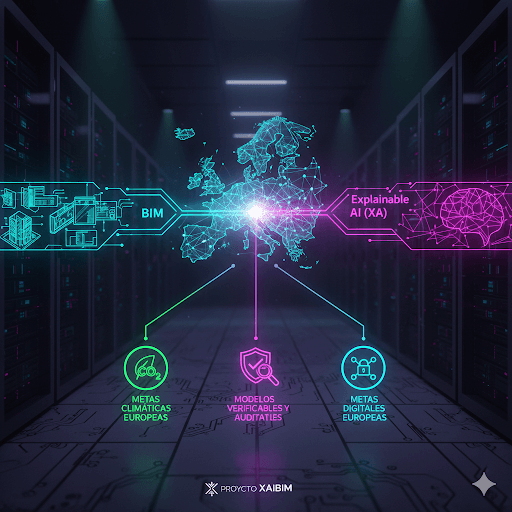
Digital Twin and Cognitive Augmentation
The agenda culminates with XAI integration (Experience Axis), positioning the system for the next generation of Digital Twins (DT) [73]. The goal is an auditable knowledge DT [74], where Cognitive Augmentation allows the professional to validate AI judgment in asset management.