
A HOLISTIC METHODOLOGY FOR TRUSTWORTHY AI
A. Fundamental Principles of the Methodology
Our methodology is built on open interoperable standards (IFC, ISO 19650). We implement a Human-Centered AI (Human-in-the-Loop) model, where Explainable AI (XAI) enhances the construction professional's capability.
[18] C. Koch, et al., '"Explainable AI for engineering design: A unified approach of systems engineering and component-based deep learning demonstrated by energy-efficient building design,"' Advanced Engineering Informatics, 2024. DOI: 10.1016/j.aei.2024.102843

B. The Genesis of Trustworthy Knowledge
The flow starts in the XAIBIM Studio, where an expert, assisted by an RAG-LLM pipeline, curates and validates information on an ifcJSON artifact. The result is a CESA (Curated, Explainable, Structured Asset), which is cryptographically sealed and stored in the CESAR repository to ensure immutable trust.
[20] S. Kim, et al., '"Smart contract swarm and multi-branch structure for secure and efficient BIM versioning in blockchain-aided common data environment,"' Computers in Industry, 2023. DOI: 10.1016/j.compind.2023.103922

C. Applied Neuro-Symbolic Reasoning
The XAIBIM Nexus applies knowledge from the CESAR through a neuro-symbolic pipeline (NLP→CNN→GNN→SWRL). Our methodology optimizes the layers of these models to execute high-performance deductive reasoning for explainable conformity verification.
[22] F. F. Tafra, et al., '"Classification of architectural and MEP BIM objects for building performance evaluation,"' Advanced Engineering Informatics, 2024. DOI: 10.1016/j.aei.2024.102503

D. From Open Source to Cognitive Interface
We implement our methodology on an open-source technological stack (Blender, IFC.js, FastAPI). The interaction between the expert and the AI takes place through a multimodal cognitive interface designed for seamless collaboration.
[24] M. Nabizadeh, et al., '"Text-to-structure interpretation of user requests in BIM interaction,"' Autom. Constr., 2025. DOI: 10.1016/j.autcon.2025.106119

E. Validation and Metrics (KPIs)
The methodology's validation is carried out through Key Performance Indicators (KPIs) that measure both workflow impact and, centrally, the quantification of explainability for each Nexus inference.
[26] H. Son, et al., '"Enhanced model tree for quantifying output variances due to random data sampling: Productivity prediction applications,"' Autom. Constr., 2024. DOI: 10.1016/j.autcon.2023.105218

Integration with Blender and Open Source Ecosystem
Our workflow integrates with leading open-source tools like Blender, not just as a visualization platform, but as an active component in the data lifecycle and AI validation.

Blender as a Synthetic Data and Validation Engine
We integrate Blender into the XAIBIM Studio MLOps flow as an engine for procedural synthetic data generation. We use its API for data augmentation and employ it as a validation environment to mitigate geometric "hallucinations" of LLMs in parametric CAD workflows.
[89]: '"The status, evolution, and future challenges of multimodal large language models (LLMs) in parametric CAD,"' Expert Systems with Applications, (2025). DOI: 10.1016/j.eswa.2025.127520

Interoperability and Semantic Validation
The integration is based on open interoperability (IfcOpenShell). To ensure CESA quality, we use the SHACL constraint language for ifcOWL ontology validation, allowing for semantic verification of complex technical requirements directly in the modeling environment.
[91]: '"Validation of technical requirements for a BIM model using semantic web technologies,"' Adv. Eng. Inform., (2024). DOI: 10.1016/j.aei.2024.102426

The Knowledge Graph and AI Agents
In Blender, we transform static BIM into a dynamic Semantic Connectivity Graph (IFC-Graph). This data structure allows XAIBIM Nexus to operate as a Multi-Agent System (MAS) and execute advanced logic, such as route calculation based on semantic relations.
[93]: '"Design of a Multi-Agent System for exploiting the communicating concrete in a SHM/BIM context,"' IFAC-PapersOnLine, (2020). DOI: 10.1016/j.ifacol.2020.11.061
The Studio-Nexus Cycle and Open Science
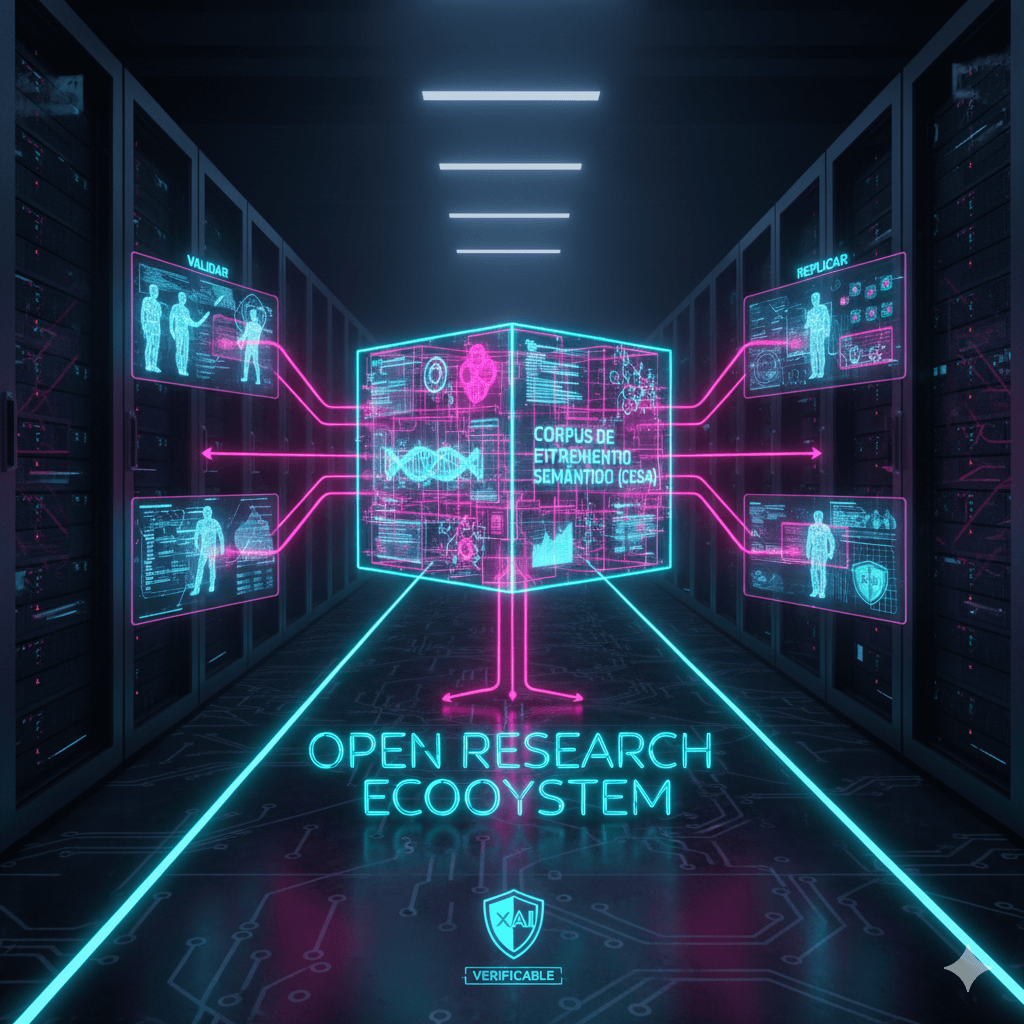
The Blender integration materializes the MLOps cycle: XAIBIM Studio generates the CESAR, an ifcJSON.XAIBIM repository that functions as a Graph-Based BIM (GBIM). XAIBIM Nexus is trained on this corpus. By publishing the CESAR, we contribute to open science for XAI research in construction.
[95]: '"Explainable artificial intelligence (XAI): Precepts, models, and opportunities for research in construction,"' Adv. Eng. Inform., (2023). DOI: 10.1016/j.aei.2023.102024
Stack Tecnológico del Frontend
Next.js y TypeScript
La plataforma se construye con Next.js como framework para Gemelos Digitales, diseñado para la integración de datos de múltiples fuentes [96]. Utilizamos TypeScript para la gobernanza del código y para garantizar la integridad estructural del artefacto ifcJSON.XAIBIM en todo el ecosistema [97].
- Persistencia Científica: Su capacidad de renderizado híbrido (SSR/SSG) asegura que los resultados publicados sean inmutables y accesibles, un requisito para la reproducibilidad de la investigación.
- Gobernanza de la Lógica: Las "Server Actions" encapsulan la lógica de negocio, creando un pipeline de datos auditable desde la interfaz hasta el backend.
- Integración de Datos: Permite la integración de datos de múltiples fuentes, fundamental para un Gemelo Digital que debe consolidar información de BIM, IoT y otras bases de datos.
[97]: S. Sepasgozar, et al., '"BIM-driven transformation of waste management toward enhanced reduction and circularity in the built environment,"' Waste Management, (2025). DOI: 10.1016/j.wasman.2025.115105

Three.js e IFC.js
El stack de visualización 3D con Three.js e IFC.js es la interfaz Human-in-the-Loop del XAIBIM Studio. Actúa como la capa de interacción para la retroalimentación visual en tiempo real [98], permitiendo al experto validar el enriquecimiento semántico derivado de procesos como la Comprobación de Relaciones Geométricas [99].
- Interfaz de Curación: Sirve como la herramienta human-in-the-loop para auditar visualmente los resultados del "Curator".
- Bucle de Retroalimentación: Constituye la capa de interacción de nuestro marco de integración físico-digital, un componente esencial para el feedback loop en tiempo real.
- Transparencia del Enriquecimiento: Hace visible el resultado del enriquecimiento semántico basado en la comprobación de relaciones geométricas.
[99]: G. Lilis, et al., '"BIM-based semantic enrichment and knowledge graph generation via geometric relation checking,"' Automation in Construction, (2025). DOI: 10.1016/j.autcon.2025.106081

Interacción Humano-Céntrica
La interfaz de usuario se construye con Tailwind CSS y Shadcn/ui para implementar un marco de trabajo centrado en el humano que garantiza la claridad en la interacción con el Gemelo Digital [100]. El sistema facilita una colaboración humano-robot eficaz entre los expertos y los agentes de IA del Nexus [101].
- Comunicación Científica Clara: Un sistema de UI consistente garantiza que la presentación de datos y métricas de XAI sea no ambigua.
- Interacción Humano-Céntrica: Implementa un marco de trabajo centrado en el humano que facilita la colaboración entre expertos, usuarios y agentes de IA.
- Accesibilidad y Colaboración: El cumplimiento de estándares como WCAG es fundamental en la colaboración humano-robot.
[101]: '"Biosignal measurement for human-robot collaboration in construction: A systematic review,"' Advanced Engineering Informatics, (2025). DOI: 10.1016/j.aei.2025.103652

Zustand para la Reproducibilidad
Utilizamos Zustand para la gestión del estado de la aplicación. Su arquitectura minimalista es fundamental para la estandarización y eficiencia en flujos de trabajo colaborativos de BIM [102] y, crucialmente, para garantizar la reproducibilidad científica de cada sesión de curación en el XAIBIM Studio [103].
- Eficiencia y Estandarización: Un gestor de estado como Zustand contribuye a la estandarización de datos y la eficiencia del sistema.
- Base para Middleware: La capacidad de Zustand para integrarse con middlewares alinea nuestra arquitectura con este enfoque para la interoperabilidad.
- Reproducibilidad Experimental: Permite guardar, compartir y restaurar el estado exacto de una sesión, un requisito para la reproducibilidad científica.
[103]: '"Semantic enrichment for BIM-based building energy performance simulations...,"' Journal of Building Engineering, (2024). DOI: 10.1016/j.jobe.2024.110312
Backend Technology Stack: The Dual AI Architecture
🧠 XAIBIM Studio Backend
Purpose: Knowledge creation. A pipeline to generate the Audited Semantic Training Corpus (CESA).
LLMs
XAIBIM Studio implements an LLM-based agent functioning as a Cognitive Assistant, allowing professionals to perform "3D spatial relationship queries" through natural language [100], an approach aligned with "technology acceptance" factors in the AECO sector [101].
- Cognitive Assistant: The AI agent assists the expert in curation, interpreting complex natural language queries.
- Intuitive Spatial Query: Resolves the challenge of extracting topological information from IFC models through a conversational interface.
- Evidence-Based Adoption: The design is based on empirical factors determining technology acceptance in the sector.
[101]: 'An interactive system for 3D spatial relationship query by integrating tree-based element indexing and LLM-based agent,' Advanced Engineering Informatics, (2025). DOI: 10.1016/j.aei.2025.103375

RAG
To mitigate "hallucinations," the Studio uses Retrieval-Augmented Generation (RAG). This enhanced knowledge framework [102] grounds LLM proposals in a verified corpus, improving the "quality and reproducibility" of generated CESAs [103].
- Evidence Grounding: Drastically reduces LLM "hallucinations" by forcing it to base its answers on reference documents.
- Quantitative Improvement: Increases the accuracy and reliability of extracted data, a requirement for high-risk systems.
- Native Traceability: Allows every piece of generated data to be intrinsically linked to its original documentary source.
[103]: 'Generative artificial intelligence in construction: A Delphi approach, framework, and case study,' Alexandria Engineering Journal, (2024). DOI: 10.1016/j.aej.2024.12.079

Blockchain
To guarantee CESAR integrity, we integrate Digital Twin and Blockchain for lifecycle management [111]. Blockchain is used to ensure the security, integrity, and transparency of each validated CESA [112].
- Immutable Record: Every expert validation is cryptographically sealed, creating a tamper-proof history.
- Decentralized Governance: Trust resides not in a central authority, but in cryptographic consensus.
- DT-BC Synergy: Enables a secure and reliable data flow between the physical asset and its validation record.
[112]: 'Integrating Digital Twin and Blockchain for dynamic building Life Cycle Sustainability Assessment,' Journal of Building Engineering, (2024). DOI: 10.1016/j.jobe.2024.111018

⚙️ XAIBIM Nexus Backend
Purpose: Knowledge application. A 'white box' Hybrid AI for semantic enrichment of BIM models.
Python/FastAPI
The ecosystem operates on a Python and FastAPI backend for its robustness in the scientific ecosystem. This architecture supports BIM workflow automation through its API [96] and the implementation of real-time predictive models [97].
- Scientific Ecosystem: Native access to cutting-edge libraries like PyTorch and Transformers.
- High Performance: FastAPI's asynchronous nature is ideal for managing AI operations without blocking the system.
- Predictive Intelligence: The architecture is designed to support not only command execution but also learning from user interaction.
[97]: 'Predictive modeling: BIM command recommendation based on large-scale usage logs,' Advanced Engineering Informatics, (2025). DOI: 10.1016/j.aei.2025.103574

MLOps and Containers
XAIBIM is built on a Service-Oriented Architecture (SoA) [98]. Each AI component is packaged in Docker containers and orchestrated through microservices [99], guaranteeing a reproducible and scalable MLOps lifecycle.
- Guaranteed Reproducibility: Docker containerization eliminates dependency issues and ensures a consistent environment.
- Scalability and Resilience: Microservices architecture allows each component to scale independently.
- CI/CD: Facilitates automation pipelines for testing and deploying new versions of AI models.
[99]: 'A Semantic Digital Twin for the Dynamic Scheduling of Industry 4.0-based Production of Precast Concrete Elements,' Advanced Engineering Informatics, (2024). DOI: 10.1016/j.aei.2024.102677
NLP, CNN, GNN, SWRL, XAI
XAIBIM Nexus executes a pipeline combining NLP with Transformers (SBERT) for semantic analysis [104], Computer Vision (Mask R-CNN) for instance segmentation [105], Topological Analysis with GNNs to understand relational context [106], and Symbolic Logic with Semantic Web (ifcOWL) for deterministic validation [107], culminating in an XAI layer (LIME) to ensure transparency [108].
- Multimodal Analysis: Processes and correlates information from texts, 2D images, and 3D models.
- Contextual Reasoning: GNNs allow AI to understand relationships between model components.
- Auditable Validation: Symbolic logic layer provides deterministic and transparent rule checking.
[105]: 'Generating BIM model from structural and architectural plans using Artificial Intelligence,' J. Build. Eng., (2023). DOI: 10.1016/j.jobe.2023.107672
[106]: 'Integrating generative and parametric design with BIM...,' Applied Sciences, (2025). DOI: 10.1016/j.apples.2025.100253
[107]: 'Knowledge-enhanced ontology-to-vector for automated ontology concept enrichment in BIM,' J. Ind. Inf. Integr., (2025). DOI: 10.1016/j.jii.2025.100836
[108]: 'A LIME-LSTSNM approach based green building sustainability prediction using BIM design,' Sustain. Comput. Inform. Syst., (2025). DOI: 10.1016/j.suscom.2025.101155

Specialized Databases
The data architecture relies on polyglot persistence. We employ Graph Databases (Neo4j) for BIM topological representation [109], Document Databases (MongoDB) for ifcJSON.XAIBIM artifacts, and Relational Databases (PostgreSQL) for transactional operational data [110].
- Optimized Storage: Each data type is stored in a system designed for maximum efficiency.
- High-Performance Queries: Allows complex topological queries in the graph database.
- Scalability and Flexibility: The architecture allows each database system to scale independently.
[110]: 'AI-driven integration of digital twins and blockchain for smart building management systems...,' Journal of Building Engineering, (2025). DOI: 10.1016/j.jobe.2025.112439

Support Infrastructure and Governance
Security, Governance, and Regulatory Compliance
The XAIBIM platform is built on a security and governance model that prioritizes human-centered innovation and regulatory compliance. We implement standard authentication flows like OAuth 2.0/JWT and use Web3 technologies to protect intellectual property. Our framework proactively addresses cybersecurity concerns and ethical AI principles, ensuring adherence to regulations such as GDPR and the EU AI Act.
Modern Authentication: Uses open standards to manage user sessions and securely protect API access.
Intellectual Property Protection: The architecture is designed to protect the confidentiality of commercial data and the intellectual property of BIM models.
[76] '"Trustworthy Artificial Intelligence in AECO: A review of ethical and legal implications,"' Eng. Const. Archit. Manag., 2024. DOI: 10.1108/ECAM-05-2023-0453.
AI Life Cycle (MLOps)
XAIBIM adopts an MLOps methodological framework for the full life cycle management of our AI models. We implement a Human-in-the-Loop (HITL) cycle where expert validation from the "Curator" feeds back into the continuous retraining of the "Engine". Our architecture separates NLP model training from its deployment on an inference server, ensuring a robust, auditable, and constantly improving process.
Continuous Improvement: The system is not static; it learns and improves continuously from expert interaction and validation.
Model Life Cycle Management: Automates the process of retraining, validation, deployment, and monitoring of AI models.
[78] '"Human-in-the-loop machine learning: A state of the art review,"' Knowl. Based Syst., 2024. DOI: 10.1016/j.knosys.2024.111823.
Human Validation (Human-in-the-Loop - HITL)
Our methodology focuses on a Human-in-the-Loop (HITL) cycle, where expert knowledge is the final authority validating the CESA. This process transforms validation into automated safety checking that not only corrects but actively improves the system's intelligence. This approach is a pillar of our data governance strategy.
Expert Validation as Source of Truth: The professional's tacit knowledge is captured and formalized as a quality standard.
Active Feedback Loop: Every expert action feeds the MLOps cycle for continuous "Engine" retraining.
[80] '"Continuous learning architectures for infrastructure asset management,"' Resour. Conserv. Recycl., 2025. DOI: 10.1016/j.resconrec.2025.107982.
Governance and Standards (ISO 19650 & AI Act)
The entire XAIBIM methodology operates under a strict governance framework, aligned with ISO 19650 for BIM information management and the principles of the EU AI Act. This approach ensures compliance with the highest interoperability standards and aligns with future digitalization and automation trends.
Compliant Information Management: The workflow is compatible with ISO 19650 principles.
Trustworthy AI by Design: The system meets EU AI Act requirements for high-risk systems.
[82] '"Regulatory compliance of AI in the European Union: The AI Act and its impact on infrastructure,"' Polit. Soc., 2023. DOI: 10.1177/00323292231189212.