
The ifcJSON.XAIBIM Artifact: A Unified Knowledge Container
Explore the core of our methodology: the ifcJSON.XAIBIM artifact. It is not a simple file, but a knowledge container structured as a queryable knowledge graph [75]. Its digital twin hypermedia architecture [76] facilitates navigation across domains and ensures the traceability required by ISO 19650 and the AI Act [77].
[76]: S. Herlé & J. Blankenbach, '"Hypermedia-driven RESTful API for digital twins of the built environment,"' Automation in Construction, (2024). DOI: 10.1016/j.autcon.2024.105551
[77]: M. Huymajer, et al., '"Building Information Modeling in the execution phase of conventional tunneling projects,"' Tunnelling and Underground Space Technology, (2024). DOI: 10.1016/j.tust.2023.105539
SANDBOX (CONCEPT)
Semantic Enrichment Example
Selected Interface Controls:
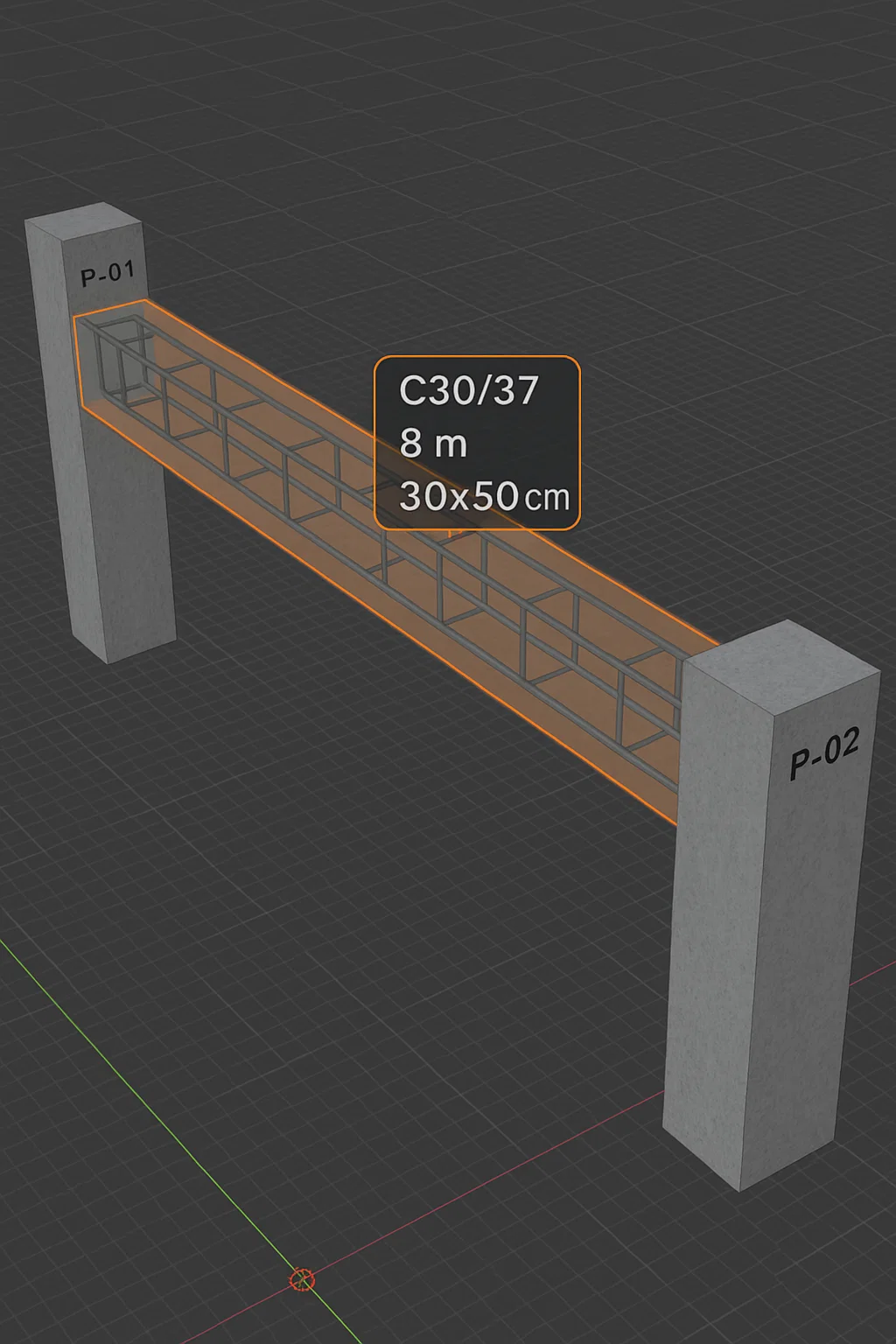
> Create reinforced concrete beam C30/37 with 8m span, section 30x50cm...
{ "id": "3.2.1.1-BEAM", "ifc_version": "IFC4.3", "project_phase": "Execution", "LOD": "300", "LOI": "300", "bim_uses": [ "03 - Interdisciplinary Coordination", "05 - Cost Estimation (5D)", "06 - Structural Analysis" ], "expected_output": { "ifc_class": "IfcBeam", "object_type": "Reinforced Concrete Beam", "tag": "V-01", "geometry": { "profile": "Rectangular", "length": 8000, "width": 300, "depth": 500 }, "psets": { "Pset_BeamCommon": { "IsLoadBearing": true, "Span": 8000 }, "Pset_FireResistance": { "FireRating": "R 90" }, "Pset_EnvironmentalImpact": { "ThermalMass": 600 } }, "materials": [ { "name": "Concrete C30/37", "category": "Concrete" }, { "name": "Steel B500S", "category": "Steel" } ], "topological_relations": [ { "type": "IfcRelConnectsStructuralElement", "relating_element": "self", "related_elements": ["IfcColumn:P-01", "IfcColumn:P-02"] } ], "MEI": { "usage_context": "Structural analysis and execution planning.", "required_loi": 300 }, "MIDE": { "entities": ["IfcBeam", "IfcRelConnectsStructuralElement"], "parameters": ["IsLoadBearing", "Span", "FireRating", "ThermalMass"] }, "norms": [ { "code": "EN 1992-1-1", "purpose": "Structural requirements verification for concrete.", "jurisdiction": "EU" }, { "code": "CTE DB-SI", "purpose": "Fire resistance verification (R 90).", "jurisdiction": "ES-MD" }, { "code": "CTE DB-HE", "purpose": "Thermal inertia contribution.", "jurisdiction": "ES-MD" } ], "bim_dimensions": { "3D": "Geometric model for coordination.", "4D": "Linked to task 'Beam Concreting Level 1'.", "5D": "Concrete volume and steel weight for cost estimation.", "6D": "Contribution to energy efficiency and safety." } }, "xai": { "ai_type": "Hybrid (Neuro-Symbolic)", "explanation": "Inferred beam. Topological relations extracted. Regulatory validations applied: Eurocode 2, CTE DB-SI (Fire) and DB-HE (Energy).", "prov": { "wasGeneratedBy": "XAIBIM_Engine_v3.3", "generatedAtTime": "2025-09-19T19:45:00Z", "blockchain_hash": "0x456def7890ghi123jkl456mno789pqr123stu456vwx789yz0123456abc" }, "confidence": 0.99 }, "training_info": { "nlp_source": "The 'text_input' (not shown) and descriptions in 'psets' and 'object_type' train the NLP engine.", "cnn_source": "A 'snapshot_3d_id' (not shown) associated with this JSON trains the vision engine for beam recognition.", "gnn_source": "The 'topological_relations' block trains the GNN engine to learn structural connection patterns.", "symbolic_source": "The 'norms' and 'psets' blocks serve as the fact base for SWRL/ISO rule validation." } }
Immutable Visual Snapshot
Each ifcJSON artifact is linked to a 3D visual snapshot, an immutable representation sealed on the blockchain. This visual record is the training source for our AI models: through image processing and object detection techniques, CNNs learn to identify visual components [86], while GNNs analyze this data as non-Euclidean information to infer complex topological relationships in the BIM context [87].
[89]: '"Graph Neural Networks for building and civil infrastructure operation and maintenance enhancement,"' Advanced Engineering Informatics, (2024). DOI: 10.1016/j.aei.2024.102868
XAI Integration and Delta Synchronization
Explainability (XAI) is integrated as a semantic data layer to ensure auditability in cross-platform collaboration [78]. Change synchronization is managed through a differential transaction (delta.patch) method, ensuring an efficient and consistent update of CESAs [79].
[79]: F. Xue & W. Lu, '"A semantic differential transaction approach...,"' Automation in Construction, (2020). DOI: 10.1016/j.autcon.2020.103270
The Human Curator Role in the MLOps Cycle
The human expert oversees the MLOps (Machine Learning Operations) cycle, validating inferences to generate CESAs. This repository of ifcJSON artifacts [80] is the basis for supervised retraining and continuous improvement of XAIBIM Nexus [81].
[81]: Y. Mo & B. Li, '"ArchiWeb: A web platform for AI-driven early-stage architectural design,"' Frontiers of Architectural Research, (2025). DOI: 10.1016/j.foar.2025.06.002
Cryptographic Seal and Immutability Guarantee
Each CESA validated in the Studio is sealed by an immutable cryptographic record on a blockchain [82]. This process ensures the integrity and non-repudiation of the data making up the CESAR throughout the asset's life cycle [83].
[83]: W. van Groesen & P. Pauwels, '"Tracking prefabricated assets and compliance using quick response (QR) codes...,"' Automation in Construction, (2022). DOI: 10.1016/j.autcon.2022.104420
Knowledge Graph and Data Provenance (W3C PROV)
We transform BIM models into an AECO Knowledge Graph using Semantic Web technologies. To ensure auditability, we record the provenance of each piece of knowledge following the W3C PROV standard [84], allowing for explicit verification of each decision in the lifecycle [85].
[85]: J. Zhu, N. Nisbet, et al., '"Releasing the power of graph for building information discovery,"' Automation in Construction, (2025). DOI: 10.1016/j.autcon.2025.106034
Standard Evolution and IFC5 Preparation
The XAIBIM architecture is designed for standard evolution, prepared to integrate construction process (as-built) data [86]. Our graph-based approach is capable of modeling the complex topological relationships that will emerge in future standards like IFC5 [87].
[87]: C. Emunds, J. Frisch, & C. van Treeck, '"Spatial Link Prediction: Learning topological relationships in MEP systems,"' Advanced Engineering Informatics, (2025). DOI: 10.1016/j.aei.2025.103414
Research Demos
Explore the multimodal assets of the XAIBIM ecosystem, including the Nexus inference engine and Studio curation workflows.
XAIBIM Nexus Engine Demo
Demonstration of the neuro-symbolic inference engine processing a BIM model for compliance checking.
XAIBIM Studio Curation Workflow
Walkthrough of the Human-in-the-Loop curation process for creating High-Fidelity CESAs.